


17 April, 2025 by Dr. Hardik Parikh
YAG Capsulotomy : A Quick and Painless Solution for Posterior Capsular Opacification

Cataract Surgery is one of the most commonly performed surgeries. Through this surgery, the patient can get rid of the cloudy formation on their lens, which causes the blurry vision. However, a few patients may have blurry vision even after the cataract surgery.
Do you know why it occurs? This phenomenon is due to Posterior Capsular Opacification(PCO).
So how can we treat this condition? With the advancement in technologies, ophthalmology has introduced a safe and effective treatment which is known as YAG capsulotomy.
This blog will help you give in-depth knowledge on understanding posterior capsular opacification, YAG capsulotomy, YAG laser
At Global Eye Clinic, recognized as one of the best eye hospitals in Mumbai and a top eye hospital in Ghatkopar, our expert team, led by Dr. Hardik Parikh, a renowned cataract surgeon in Mumbai, ensures that every patient receives world-class care with cutting-edge technology and personalized treatment plans.
Comprehending Posterior Capsular Opacification

Posterior Capsular Opacification(PCO) is a common complication that affects patients after the cataract surgery. It is the condition where the capsule behind the intraocular lens (IOL) becomes opaque or cloudy. This condition doesn’t need to occur immediately after the cataract surgery, it may occur months or even years after a successful cataract surgery.
PCOD occurs when the residual lens epithelial cells grow and migrate which were left behind on the posterior capsule during the original surgery. This will lead to the thickening of the lens over the years.
Due to this thickening, the vision may become blurry. If you had cataract surgery in both your eyes, it is possible to have PCO in both eyes, and it need not occur at the same time. The PCO can occur at different intervals of time.
The best treatment to get rid of the PCO is the YAG capsulotomy. YAG laser after cataract surgery is very common. We will see in detail the YAG capsulotomy and the details of the surgery.
What is YAG Capsulotomy?

YAG Capsulotomy is a quick and simple laser performed in an OPD setup. During this procedure, a simple laser treatment is carried out to treat the Posterior Capsular Opacification.
During the procedure, the YAG laser is focused on the posterior capsule. The laser fires a precise pulse of energy which slices the posterior capsule making a small opening in the cloudy membrane.
The Procedure: All about YAG Laser After Cataract Surgery
YAG laser is a simple procedure that takes about 2 minutes. Here are the steps you need to follow before the YAG laser after cataract surgery.
How to Prepare for YAG Capsulotomy?
Unlike catract surgery, the YAG capsulotomy does not require any preprations. The patients are asked to come at the scheduled time by the eye specialist. They will prepare you for the outpatient procedure.
What Happens During the Procedure?
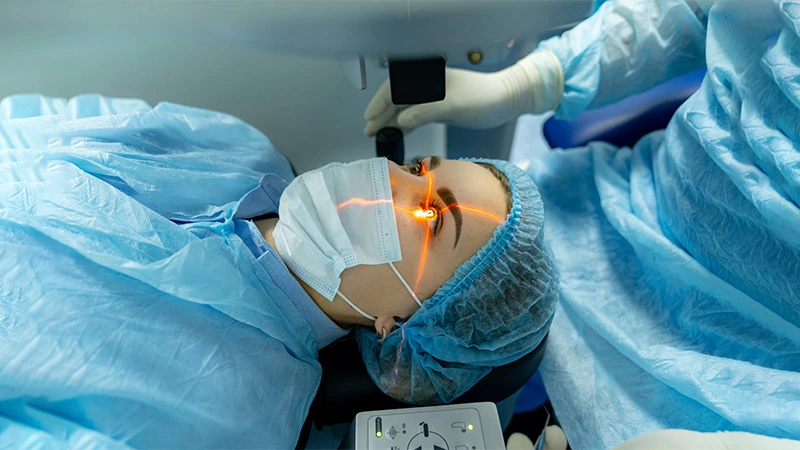
The YAG capsulotomy procedure starts by making the patient sit straight on the chair facing the laser. You need to focus on a single point faced in front of you.
- Laser Programming: The ophthalmologist set up the laser in a way that it bursts short emissions of the energy in a systemic pattern.
- Laser Activation: Once the initial process is set up, the actual procedure will begin.
The laser is fired, and it will be placed straight on your eyes. You will not feel anything. The whole procedure will be completed in less than 5 minutes. Once the procedure is done, you can go home.
Benefits of YAG Capsulotomy
The advantages of the YAG Capsulotomy are as follows.
❖ Improved Vision: With the help of YAG capsulotomy, the patients have reported gaining clear vision. This will give a swift and significant improvement in vision.
❖ It is safe: YAG capsulotomy is a safe procedure with minimal risks. With the advancement in technologies, the complications have been greatly reduced.
❖ It’s Effective: Recent studies have shown that around 83% to 96% of the patients who have undergone YAG capsulotomy show significant improvement in sight. These procedures have given a permanent solution to their problems.
❖ There is no pain or discomfort: This is a very simple procedure, and you will feel no pain during the procedure as your eyes are numb.
❖ Convenience and Cost-effectiveness: The procedure is very convenient. You do not need external surgical preparations. The whole procedure is done in a clinical set up and hence very cost-effective.
YAG Laser Capsulotomy Recovery Time
- The eye drops that dilate your pupils may take few hours to be cleared. It is advisable not to drive back home after the laser surgery.
- As this is simple procedure with no cuts , you can resume your daily activities once the vision is completely cleared.
Average Cost of YAG Laser Capsulotomy
YAG laser capsulotomy is a cost effective procedure. The average cost of YAG laser capsulotomy is about INR 5,000 per eye.
Final Thoughts,
Posterior Capsular Opacification is a very common condition. With YAG capsulotomy laser , you can get rid of this condition and get a clear vision. YAG capsulotomy is a quick, painless, and safe procedure that can significantly improve vision affected by PCO. With our in-house YAG capsulotomy machine, we can provide our patients with the best possible outcomes. If you’re experiencing blurry vision after cataract surgery, contact us to learn more about YAG capsulotomy.
If you’re considering YAG Capsulotomy laser surgery, schedule a consultation at Global Eye Clinic, your trusted partner in eye care, and experience the clarity you deserve.
Contact us today to book an appointment with Dr. Hardik Parikh, one of the top cataract surgeons in Mumbai. +919500895970
Frequently Asked Questions
What is the cost of YAG capsulotomy?
YAG capsulotomy is a quick, 5-minute outpatient laser procedure used to treat posterior capsule opacification (PCO), a common condition that can cause gradual blurring of vision. It is a minimally invasive, painless laser treatment performed in the outpatient laser room, without the need for admission or an operating theatre, and is typically completed in a single visit.
Is YAG capsulotomy covered under health insurance?
YAG laser capsulotomy is a standard medical treatment used to restore clear vision. At Global Eye Clinic Mumbai, YAG laser treatment is considered a medically indicated outpatient procedure and may be covered under health insurance in many cases, However, coverage is not uniform and depends on individual policy terms, insurer guidelines, and TPA conditions ,therefore approval may vary from case to case. Patients are advised to confirm exact eligibility and coverage details directly with their insurance provider or TPA. Our insurance team assists with documentation and claim submission wherever applicable to facilitate the process.
How quickly does vision improve after YAG capsulotomy?
Most patients experience a noticeable improvement in vision within 24 hours after YAG laser capsulotomy. At Global Eye Clinic Mumbai, this is a quick 5–10 minute outpatient laser procedure performed without admission or recovery downtime. Vision typically improves rapidly, and patients can resume normal activities soon after treatment. Once treated, posterior capsule opacification (PCO) does not recur in the same eye, making YAG laser capsulotomy a definitive and effective solution for this condition.
Categories
- Advanced Cataract Surgery
- Advanced Laser ICL Surgery
- Blurry Vision
- Cashless Eye Surgeries
- Cataract
- Cataract Surgery
- Cataract Surgery in Mumbai
- Cataracts
- computer eye strain
- Contoura Vision Surgery
- Dhanwantri Award 2025
- Diabetic Cataract Treatment
- digital eye strain
- Dry Eye
- Dry Eye Treatment
- Dry Eyes
- Eye Care
- Eye Surgery
- General
- Glaucoma
- Glaucoma Treatment
- Keratoconus
- Keratoconus Treatment
- Laser Cataract Surgery
- Laser Eye Surgeries
- Laser Eye Surgery
- Laser Vision Correction
- Lasik
- LASIK Eye Surgery
- LASIK Surgery
- Ophthalmology
- Retina Lasers
- retinal surgery
- Vision Correction
Recent Posts
- Zero-Pain Advanced Laser Cataract Surgery in Mumbai | Global Eye Clinic
- From Australia to Mumbai for Clearer Vision: Why Mr. David and Mrs. Pamela Chose Dr. Hardik Parikh for Advanced Cataract Surgery
- LASIK Surgery for NRIs: 7 Things to Plan Before Booking Your Flight
- Top 7 Symptoms That Mean You May Need Cataract Surgery Soon
- Cataract Surgery for Corporate Employees: 9 Things TCS, HDFC & Accenture Staff Must Know


Shop Zone Building, 3rd and 5th floor, Mahatma Gandhi Rd, Ghatkopar West, Mumbai, Maharashtra 400086
Landmark: Above Colors showroom , Next to bank of India
+91 95008 95970, +91 77770 56708
[email protected]
[email protected]
Office Hours:
Mon - Sat : 9:00 AM to 9:00 PM