


12 June, 2026 by Dr. Hardik Parikh
Top 7 Symptoms That Mean You May Need Cataract Surgery Soon
A cataract is a “progressive opacification” (commonly known as clouding) of the eye’s natural lens, which focuses light onto the retina. Usually, such clouding causes:
- Blurred vision
- Glare sensitivity
- Reduced night vision
- Faded color perception, and
- Difficulty performing routine visual tasks
Clinically, it has been observed that this condition progresses gradually, and there are several symptoms you may notice during this course of progression. Want to know about them? Read this article to know about 7 different symptoms that need cataract surgery.
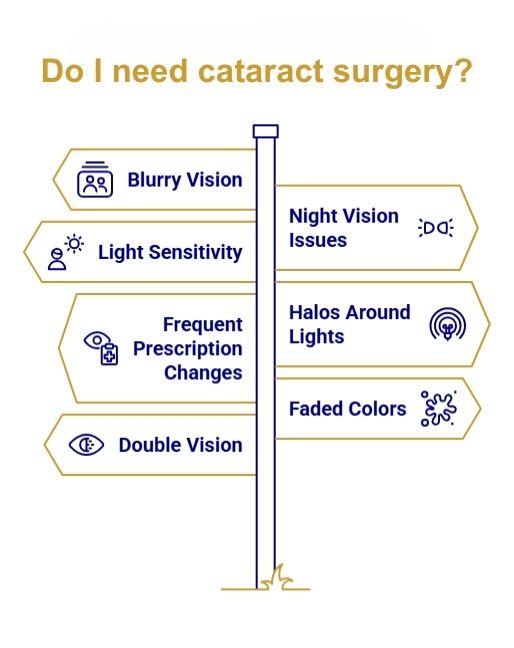
1. When “Blurry Vision” Starts Affecting Daily Activities
One of the most common cataract surgery signs is vision that remains blurry even after changing glasses or contact lenses. Many people feel as if they are looking through smoke, fog, or a dirty glass surface.
In the beginning, a new prescription may help for a short time, but the improvement usually does not last. But why does this happen? That’s because the problem is inside the eye’s natural lens and not in the external power of the eye.
As the cataract grows, the lens becomes more cloudy, and glasses cannot fully correct the issue. Consequently, you may notice problems such as:
- Difficulty reading books, phone screens, or labels
- Trouble recognising faces from a distance
- Poor image sharpness while watching television
2. Bright Lights Begin Causing Glare, Halos, and Eye Discomfort
Another major cataract surgery sign is increased sensitivity to bright light. Many patients notice that sunlight, headlights, or indoor lighting suddenly feels harsh and uncomfortable. This symptom becomes particularly noticeable while driving at night.
Reason? The cloudy lens inside the eye scatters incoming light in different directions. Instead of forming a “stable image”, the light spreads unevenly, creating glare and halos around bright objects.
As a result, patients usually make these common complaints:
- Headlights appearing too bright during night driving
- Halos or glowing rings around lights
- Difficulty looking at sunlight or LED screens
- Eye strain in brightly lit rooms
3. Poor Night Vision and Difficulty Seeing in Dim Lighting
Many people with cataracts struggle in dark or low-light environments. This symptom may develop gradually, making it difficult to notice at first. Since seeing becomes uncomfortable, you may:
- Begin turning on extra lights at home
- or
- Avoid poorly lit areas
Realise that cataracts reduce the amount of light entering the eye. At the same time, the cloudy lens makes it harder to separate objects from their surroundings in dim conditions.
Consequently, you may experience:
- Difficulty walking in dark hallways or staircases
- Problems reading under normal room lighting
- Reduced confidence while driving after sunset
- Increased dependence on brighter lights indoors
Among all symptoms that need cataract surgery, poor night vision can have a major effect on independence and mobility. If low-light vision problems continue worsening, eye specialists may recommend surgery to restore more functional vision.
4. When Colors Start Looking Dull, Yellow, or Washed Out
One of the lesser-known blurry vision cataract signs is a gradual change in “color perception”. Many people notice that colors no longer appear bright or natural.
- White objects may begin looking yellowish
- Similar shades may become difficult to distinguish
But why? As cataracts progress, the eye’s natural lens slowly develops a yellow or brown tint. This “discoloration” affects how colors are seen in daily life. Consequently, you may notice problems such as:
- Difficulty matching clothing colors
- White walls or paper appearing yellow
- Bright objects looking dull or faded
- Trouble identifying similar shades
Since this change develops slowly, many people adapt without realizing how much their vision has changed. In several cases, patients recognise the difference only after treatment.
5. Seeing “Double Images” Even with One Eye Open
Another major symptom that you need cataract surgery is “double vision” in one eye. This sign differs from standard double vision caused by eye alignment problems. In cataracts, the duplicate image may remain visible even if one eye is closed.
Many patients describe seeing a faint second image or shadow beside the actual object. This occurs because the cloudy lens scatters incoming light unevenly, causing the eye to produce multiple images.
Some common patient experiences include:
- Shadow-like duplicate images
- Difficulty reading signs or subtitles
- Overlapping letters while reading
- Eye discomfort during detailed tasks
Persistent double vision usually interferes with reading, driving, and distance judgment. Although cataracts are a common reason behind this issue, doctors may also perform a full eye examination to rule out other conditions.
6. Constant Need to Change Glasses or Contact Lens Prescription
Frequent changes in eyeglass or contact lens prescriptions may also indicate worsening cataracts. In the early and middle stages, cataracts can alter the shape and density of the eye’s natural lens. As a result, vision changes repeatedly over short periods.
Many people notice that a newly updated prescription works for only a limited time before vision problems return. This cycle may continue despite regular eye checkups.
Clinically, it has been observed that patients experience:
- Repeated prescription changes within short intervals
- Temporary improvement after getting new glasses
- Return of blurry vision, cataract symptoms soon afterward
- Difficulty reading or seeing distant objects despite corrective lenses
When prescription changes become frequent without long-term improvement, such a pattern suggests that the issue is no longer related only to eyeglass power, and cataract surgery may be required.
7. When Vision Problems Begin Impacting Your Daily Life
Among all symptoms that need cataract surgery, the biggest warning sign is their impact on your daily routine and independence. Cataracts may not become dangerous overnight, but they can slowly reduce your ability to perform normal activities. In many cases, patients even start avoiding hobbies, social gatherings, or outdoor activities.
You may notice situations such as:
- Dependence on brighter lights for routine tasks
- Avoiding night driving due to glare or poor visibility
- Difficulty recognizing faces from a distance
- Trouble working on computers or reading documents
- Greater dependence on family members for support
Realise that the decision related to “when is cataract surgery needed” does not depend only on eye test numbers. Most doctors evaluate the need for cataract surgery based on how much cataracts are affecting your lifestyle, mobility, safety, and independence.
Even “moderate vision loss” can justify surgery if it is interfering with work, household activities, travel, or social interaction.
Are You Observing Cataract Surgery Signs? Book Your Eye Checkup at Global Eye Clinic, Ghatkopar, Mumbai
So now you know that cataracts develop progressively, and several signs indicate a potential cataract surgery. If we were to revise, some common symptoms are:
- Persistent blurry or cloudy vision despite new glasses
- Increased glare and sensitivity to bright lights
- Difficulty seeing at night or in dim lighting
- Colors appear faded, yellowish, or dull
- Double vision in one eye
- Frequent changes in eyeglass prescriptions without long-term improvement
If these cataract surgery signs are affecting your routine activities, mobility, reading, driving, or work, it may be time to consult a specialist.
For advanced cataract care, Global Eye Clinic, Ghatkopar, Mumbai, is a trusted choice with JCI accreditation and advanced surgical technology. The clinic is led by Dr. Hardik Parikh, Chief Surgeon and Medical Director.
If you are looking for cataract surgery in Mumbai, Global Eye Clinic offers world-class cataract treatment using the latest surgical technologies, advanced laser systems, and internationally accredited safety standards. Led by Dr. Hardik Parikh, our team is committed to delivering exceptional visual outcomes with personalized care.
As one of the leading eye hospitals in Mumbai, we combine advanced diagnostics, premium intraocular lenses (IOLs), and state-of-the-art operating facilities to provide safe, precise, and effective cataract surgery
Symptoms That Need Cataract Surgery FAQs
1. How does a cataract develop and is treated?
Cataract develops when lens proteins begin to break down and aggregate. Such an aggregation reduces the passage of light and impairs visual clarity. Gradually, it leads to “progressive opacification” of the eye’s natural lens. It is treated through surgical removal of the cloudy lens, followed by implantation of an intraocular lens (IOL).
Furthermore, age-related cataracts are the most common type, though they may also result from trauma, diabetes, prolonged steroid use, or genetic factors.
2. How do I know when cataract surgery is needed?
Cataract surgery is usually recommended when vision problems begin affecting daily activities such as reading, driving, working, or recognising faces. Some common symptoms that need cataract surgery include:
- Blurry vision
- Glare sensitivity
- Poor night vision, and
- Repeated prescription changes
3. Can glasses stop blurry vision caused by cataracts?
In the early stages, glasses may restore blurry vision. However, as the cataract progresses, the clouding inside the lens increases, and glasses stop giving lasting improvement. In such cases, a cataract surgery may be required.
4. Does Global Eye Clinic provide cashless insurance support for cataract surgery?
Yes, Global Eye Clinic offers cashless insurance support through 20+ TPAs and insurance providers, including HDFC Ergo, Star Health, Bajaj Allianz, Mediassist, Vidal Health, Chola MS, Reliance General, and more.
Patients can contact the clinic at +91 9500895970 for consultations, and cataract surgery appointments.
Category : Advanced Cataract Surgery , Cataract , Cataract Surgery
Categories
- Advanced Cataract Surgery
- Advanced Laser ICL Surgery
- Blurry Vision
- Cashless Eye Surgeries
- Cataract
- Cataract Surgery
- Cataract Surgery in Mumbai
- Cataracts
- computer eye strain
- Contoura Vision Surgery
- Dhanwantri Award 2025
- Diabetic Cataract Treatment
- digital eye strain
- Dry Eye
- Dry Eye Treatment
- Dry Eyes
- Eye Care
- Eye Surgery
- General
- Glaucoma
- Glaucoma Treatment
- Keratoconus
- Keratoconus Treatment
- Laser Cataract Surgery
- Laser Eye Surgeries
- Laser Eye Surgery
- Laser Vision Correction
- Lasik
- LASIK Eye Surgery
- LASIK Surgery
- Ophthalmology
- Retina Lasers
- retinal surgery
- Vision Correction
Recent Posts
- Zero-Pain Advanced Laser Cataract Surgery in Mumbai | Global Eye Clinic
- From Australia to Mumbai for Clearer Vision: Why Mr. David and Mrs. Pamela Chose Dr. Hardik Parikh for Advanced Cataract Surgery
- LASIK Surgery for NRIs: 7 Things to Plan Before Booking Your Flight
- Top 7 Symptoms That Mean You May Need Cataract Surgery Soon
- Cataract Surgery for Corporate Employees: 9 Things TCS, HDFC & Accenture Staff Must Know


Shop Zone Building, 3rd and 5th floor, Mahatma Gandhi Rd, Ghatkopar West, Mumbai, Maharashtra 400086
Landmark: Above Colors showroom , Next to bank of India
+91 95008 95970, +91 77770 56708
[email protected]
[email protected]
Office Hours:
Mon - Sat : 9:00 AM to 9:00 PM